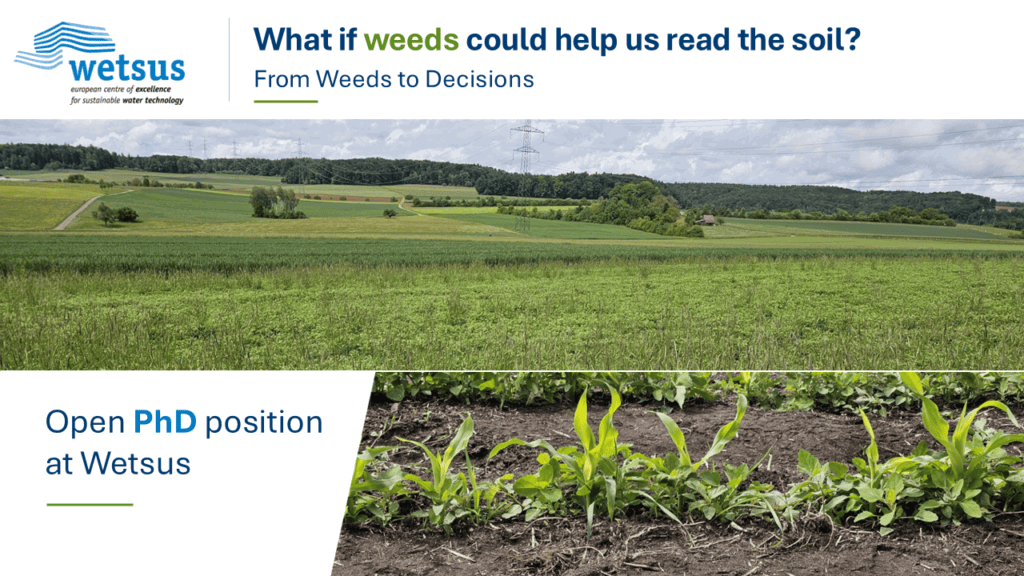
From Weeds to Decisions: AI-driven Soil Insight and Precision Management Using Weed Indicators
Weed plant communities in agricultural fields are rarely randomly distributed, and their species patterns often reflect underlying soil chemical, physical, and biological properties. This project explores the use of weeds as practical bio-indicators of soil status by integrating high-resolution optical sensing, plant trait analysis, and soil measurements. Proximal sensing enables spatially explicit species recognition and extraction of plant functional traits. These plant-derived indicators can be linked with soil properties describing nutrient availability, structure, moisture dynamics, and microbiota. The core idea is that weed plant traits encode signals of soil constraints and ecological niches. Using AI-driven approaches, the project aims to develop a non-destructive framework for soil characterization and field heterogeneity mapping, supporting precision agriculture.
Research challenges
Although ecological evidence links weed communities to soil conditions, predictive plant–soil inference in agricultural fields is still limited. Weed distributions are highly dynamic, influenced by crop rotation, management history, disturbance, and plant–soil feedback, creating complex nonlinear patterns where species presence alone cannot explain soil variability. Key challenges include separating soil signals from management effects, integrating multi-scale datasets, and accounting for microbiome interactions affecting weed and crop performance. In addition, optical plant traits must be translated into biologically meaningful indicators for robust modelling. Many existing AI approaches function as black boxes, limiting practical adoption. This project addresses these gaps by developing transparent AI frameworks that integrate species recognition, trait extraction, and soil sensing to predict soil properties while ecologically explaining disease risks and abiotic or biotic stress patterns
Your assignment
You will develop an AI-enabled framework linking weed species composition and functional traits to soil properties and agroecosystem outcomes. The work includes extracting quantitative plant traits from spectral and imaging data, analysing soil physicochemical and microbiome datasets, and constructing models that infer soil conditions from plant indicators. A key objective is model interpretability. You will apply interpretable machine learning techniques to quantify feature importance and reveal which plant traits, species, and trait–soil interactions contribute most to model predictions. You will also investigate plant–soil feedback processes and assess whether weed characteristics can forecast subsequent crop performance, disease risk, and abiotic or biotic stress.
The position involves mainly data analysis and predictive modelling, and potentially interdisciplinary experimentation and field campaigns depending on data availability. Expected outputs include field-specific spatial soil maps, decision-support tools enabling farmers to estimate soil variability through weed observations, reducing sampling efforts while supporting targeted soil management, crop protection, and rotation planning.
Your profile
You hold a master’s degree in data science or geo-information sciences and have basic knowledge in soil sciences, plant sciences, environmental sciences, or a related discipline combining quantitative methods with ecological or agricultural sciences. You are comfortable with data analysis and statistical modelling. Familiarity with machine learning methods, GIS, or spectral data analysis is an advantage. You are independent and curious about ecological processes and are motivated to work across disciplinary boundaries in an international and dynamic research environment. A driver’s license and ability to communicate in Dutch are a plus.
Keywords: Machine learning; GIS; Proximal sensing; field spectroscopy; soil biology; plant traits
Professor/University group/Wetsus supervisor(s):
University promotor: Prof. Dr. Martijn Bezemer, Institute of Biology, Leiden University
Wetsus supervisor(s): Dr. Jiahui Gu and Dr. Mohamed Zakaria Hatim
Project partners: Soil
Only applications that are complete, in English, and submitted via the application webpage before the deadline will be considered eligible.
Guidelines for applicants: https://www.phdpositionswetsus.eu/guide-for-applicants/