
This PhD vacancy has been withdrawn; however, all candidates will still be notified of their evaluation scores by 6 May 2026.
Short chain PFAS adsorption and destruction
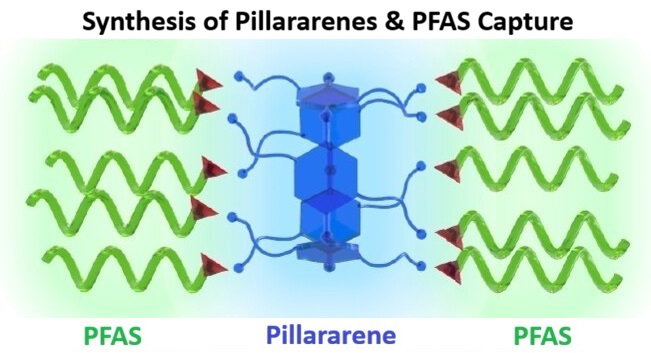
Pillararene-based short-chain PFAS capture, release and destruction
The presence of perfluoroalkyl and polyfluoroalkyl substances (PFAS) in water is an increasing societal concern. These compounds are extremely persistent, and growing evidence links them to adverse health effects in humans and animals. Their removal and safe destruction are therefore essential. Longer-chain PFAS, such as PFOS and PFOA, can be removed to some extent using activated carbon or ion exchange resins. However, these approaches are less effective for short-chain PFAS and are not sustainable in the long term. Short-chain PFAS are typically defined as substances with six or fewer fully fluorinated carbon atoms. Due to their higher water solubility and lower hydrophobicity, they are more mobile in aquatic systems and more difficult to capture with conventional adsorption materials. As a result, they spread more easily through water bodies. Successfully addressing short-chain PFAS would provide a sustainable and scalable solution for one of the most persistent classes of water pollutants, improving water quality and reducing environmental and health risks.
Research challenges
Pillararene-based macrocyclic adsorbents, developed by the Zuilhof group (Wageningen University, Laboratory of Organic Chemistry) have shown strong and selective binding of longer-chain PFAS through cooperative fluorine–fluorine interactions. They can also be regenerated under mild conditions. However, their performance for substantially shorter-chain PFAS remains unclear, as these interactions are expected to weaken with decreasing chain length. This project focuses on the efficient capture of short-chain PFAS and on developing methods to destroy the highly concentrated PFAS streams generated after adsorption. Combined mechanochemical and chemical treatments will be explored to achieve effective defluorination for PFAS in the concentrated streams.
Your assignment
You will design and synthesise pillararene-based molecules for the adsorption of short-chain PFAS and translate this into a practical adsorption technology. You will study the binding interactions between these molecules and PFAS from an organic chemistry perspective, as well as evaluate performance via batch and column experiments. In addition, you will investigate regeneration strategies to achieve higher concentration factors and explore the mineralisation of concentrated PFAS, aiming for near-complete defluorination through mechanochemical, thermal, or chemical approaches. Building on the work within the Integrated PFAS Treatment theme: Jesse Goed’s mechanistic studies (understanding the origin of adsorption performance) and Rick Nooijen’s work on scalability and regeneration, you will help advance both fundamental insight and technological application.
Your profile
We are looking for a student having an MSc in Chemistry with extensive experience in organic chemistry, excellent command of English, an inquisitive mind that places question marks at most answers, and a real drive to dive into a demanding research project. You have interest in organic synthesis and detailed physical measurements, and want to combine fundamental science with an urgent societal goal. You have strong experimental skills, critically analyse data and scientific literature, identify key technological mechanisms from evidence and theory, and clearly communicate your research through discussions, presentations, and scientific writing.
Keywords: PFAS; organic chemistry; water treatment; adsorption-regeneration; defluoronation
Professor/University group/Wetsus supervisor(s):
University promotor and co-promotor: Prof. Dr. Han Zuilhof, Dr. Eva J. Meeus and Dr. Fedor Miloserdov (Wageningen University, Laboratory of Organic Chemistry)
Wetsus supervisor(s): Dr. Amanda Larasati
Project partners: Integrated PFAS Treatment theme
Only applications that are complete, in English, and submitted via the application webpage before the deadline will be considered eligible.
Guidelines for applicants: https://www.phdpositionswetsus.eu/guide-for-applicants/
This PhD vacancy has been withdrawn; however, all candidates will still be notified of their evaluation scores by 6 May 2026.